Mission alignment with funders: what it is, how to assess it, and why it matters
May 07, 2026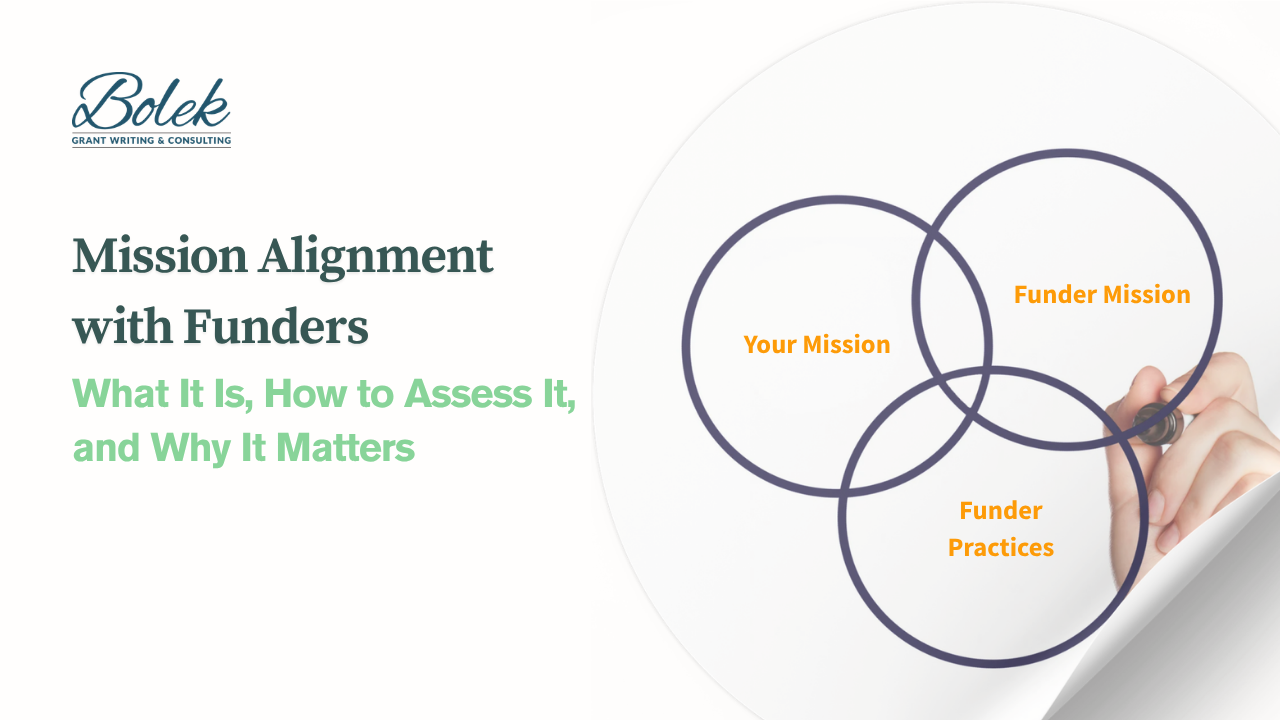
Funders and nonprofits often talk about being “mission aligned.” Sometimes it is treated like a warm-and-fuzzy concept that you either have or you do not. In reality, mission alignment is a practical, measurable fit between three things:
- What your organization exists to do (mission, strategy, priorities)
- What the funder exists to do (mission, focus areas, theory of change)
- How the funder does it (values, decision criteria, grantmaking practices)
When those elements match, the partnership is easier. Your proposal is clearer. Reporting feels less like gymnastics. Renewal is more likely. When they do not match, even a “yes” can become a painful relationship over time.
This is why I treat mission alignment as a scoring criterion in funder relationship nurturing. It is one of the strongest predictors of whether your time will turn into dollars and, just as importantly, whether those dollars will move your mission forward.
What “mission alignment” is (and what it is not)
Mission alignment is not:
- Getting an exception because you have a compelling story
- Twisting your language to match a funder’s buzzwords
- Chasing a one-time opportunity that pulls you away from your priorities
Mission alignment is:
- A shared understanding of the problem you are solving
- Agreement on the population and geography you serve
- Agreement on the approach that leads to change
- A funder’s values and practices being compatible with how you operate
Why mission alignment matters more than “eligibility”
Many organizations stop at eligibility: “Are we a 501(c)(3)? Do we serve the right region? Is our program in their list?”
Eligibility is the baseline. Alignment is what determines whether you can compete.
Two organizations can both be eligible, but:
- One is clearly advancing the funder’s stated outcomes.
- The other is simply adjacent.
Funders can feel the difference quickly, especially when they have more strong requests than they can fund.
Mission alignment: the key dimensions to look for
You do not need a complex system to spot alignment quickly. Most of the time, it comes down to whether there is a real fit across a few dimensions:
- Your work clearly advances the outcomes the funder exists to create.
- You serve the people and geography the funder prioritizes.
- The funder supports the type of work you actually do, not a watered-down version of it.
- Their expectations match how you operate, including how they treat community voice, “credit,” and grantee autonomy.
- The reporting, restrictions, and timelines will not strain your capacity or push you off strategy.
A quick way to think about “fit” (without over-analyzing)
If you want a fast gut-check, ask:
- Would we still want this relationship if the grant were smaller?
- Would we be proud to talk about this funder publicly as a close partner?
- If the funder asked for a story, data point, or program shift, would it still feel true to our work?
When the answer is consistently “yes,” alignment is usually high. When you find yourself needing to justify the relationship internally, that is often a warning sign.
Common traps (and how to avoid them)
Trap 1: “We can make it fit.”
If you have to contort your program description to sound aligned, the partnership will likely stay contorted.
Better question: What would we have to change about our work to be a natural fit, and is that change worth it?
Trap 2: Confusing need with alignment
Your community’s need can be urgent and real, and the funder can still be the wrong fit.
Better question: Which funders are designed to support this work at this moment?
Trap 3: Letting a large grant override strategy
Big dollars can be seductive. If the restrictions or expectations will pull you off mission, it can cost more than it gives.
Better question: What is the true cost of this money in time, reporting, brand, and program drift?
How mission alignment fits into funder relationship nurturing
When you use alignment as a criterion in your relationship nurturing or workflow, you unlock a few advantages:
- You prioritize outreach to the funders most likely to say yes.
- You avoid investing months in relationships that will stall.
- You tailor communication to the funder’s real motivations.
- You build a healthier portfolio where funders reinforce your mission instead of reshaping it.
If you want a simple way to operationalize this, start by adding a mission alignment score to your funder profiles and requiring a short justification note before anyone moves a funder into active cultivation.
Remember, mission alignment is not about getting funders to like you. It is about choosing partners whose goals, values, and practices make it easier to deliver on your mission.
The best funder relationships feel obvious in hindsight. A clear mission alignment process helps you find those relationships on purpose.